Июнь
2026 г. |
Российская наука и мир
(по материалам зарубежной электронной прессы) |
Исследователи из Окинавского научно-технологического института (Япония) и Института белка РАН описали адаптационные механизмы, позволяющие галофильным археям Haloarcula marismortui выживать в Мертвом море при температуре до 50°C и концентрации соли более 30%. Эти одноклеточные имеют уникальную структуру внешней оболочки жгутиков-археллумов, спиральных белковых нитей, обеспечивающих движение архей. Ученые полагают, что особая структура придает археллумам жесткость и прочность и позволяет микроорганизмам лучше плавать в плотной воде, а также изменять свойства своих нитей для повышения адаптации к окружающей среде.
Living in the Dead Sea would be a very unpleasant experience for most creatures. With salt concentration above 30% and temperatures ranging from 10-50°C, it takes unique environmental adaptations to survive in such harsh conditions.
In a new Nature Communications study, researchers from the Okinawa Institute of Science and Technology (OIST) and the Institute of Protein Research of the Russian Academy of Sciences have described in detail a structural adaptation supporting one of the Dead Sea's few hardy inhabitants - a single-celled archaea called Haloarcula marismortui (H. marismortui). Using single-particle cryo-electron microscopy (cryo-EM), the researchers characterize the proteins that form the archaeal filament, a long tail-like structure essential for movement.
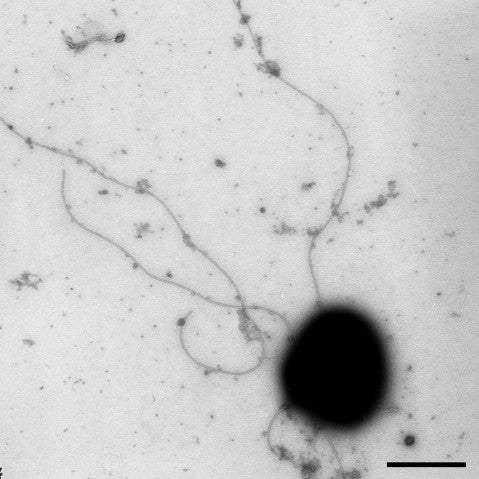
The image shows a complete H. marismortui cell, captured by one of the co-authors in a previous paper. The long tubular extensions seen in the picture are the archaeal filaments, which stretch out from the main body of the cell. The scale bar (1 μm) shows the size of the cell.
First author Dr. Vladimir Meshcheryakov of the Molecular Cryo-Electron Microscopy Unit at OIST explains the significance of their findings. "While we as humans might not notice as much difference swimming through higher salt concentrations, to a single-celled organism, mobility gets much more difficult as their environment is more viscous. These archaea have a unique outer sheath structure in their filaments, not previously found in any other archaea. We believe this is to stiffen and strengthen the filament, to help them swim better in viscous conditions."
Co-author Professor Matthias Wolf adds, "Studying organisms like this which live under extreme conditions can give us insights into the unique environmental adaptations needed to support life in different contexts. For example, if one day we were to find life on other planets, it would likely be similar creatures to these archaea, with specific adaptations tailored for survival."
Swimming through salty waters
To survive, most creatures need to stay mobile, generally moving away from threats and towards safety, food and friends. In archaea, this movement is powered by a large, helical protein structure called the archaeal filament, or archaellum, which rotates due to a membrane-anchored protein motor connecting it to the rest of the cell.
In H. marismortui, this filament is formed of one of two different types of subunits (ArlA2 or ArlB), depending on which genes are switched on to code for the proteins. "This variation can provide extra defense against antibodies or phages that might try to bind onto a specific site," explains Wolf.
Such variation may also support environmental adaptation. The researchers discovered that although each of the two protein complexes share the same set of core components (a long polypeptide chain, an inner core and outer sheath), they display very different outer sheath structures.
"When the ArlB monomer units combine together, their D2 sections can flip orientation, which enables very strong interactions to form between monomers," says Meshcheryakov. "This creates a strong, rigid outer sheath structure as needed for more powerful movement in saltier waters."
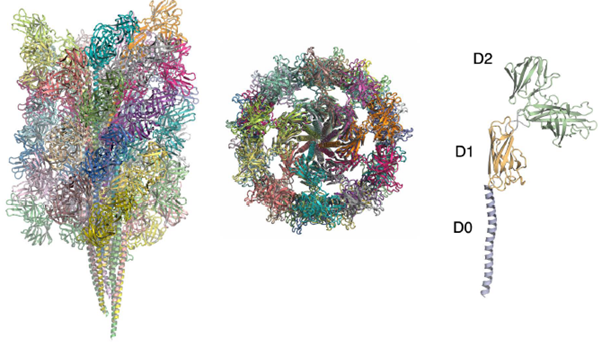
Using cryo-EM, the team characterized two different types of filaments (made up of proteins known as ArlA2 and ArlB), coded for by different genes.The image here shows the ArlB filament, with the monomer, split into three domains pictured on the right. The D2 domain forms the outer sheath (the outer ring visible in the central image), with strong interactions to neighboring monomers creating a more rigid structure, perfect for powering movement through viscous waters with high salt concentration.
In contrast, ArlA2 filaments have much weaker interactions between each monomer's D2 domains, and the researchers pin this down to environmental adaptation. ArlB proteins are adapted to suit much higher salt concentrations than ArlA2.
"ArlA2 functions in a wide range of temperatures and salinity (salt concentrations), while ArlB is adapted specifically for high salt and lower temperature conditions. That's why most of the time we see ArlA2 in wild-type H. marismortui," adds Meshcheryakov.
Converging solutions in evolution
Bacteria and archaea diverged from a common ancestor around 4 billion years ago. Most bacterial flagella (their archaeal filament equivalents) have an outer sheath structure. Yet, up until now, no other archaea had been characterized with this structure. The study presents the first example of convergent evolution in the filaments that power movement in these organisms.
Wolf comments, "These kinds of studies can help us unlock new insights into how life evolves and adapts. For example, over billions of years, both bacteria and archaea came up with similar, but ultimately molecularly, structurally different solutions to swim. With archaea being the ancestors of eukaryotic cells, like our mammalian cells, there's a lot to learn by studying such organisms."
Copyright © 2011-2026 Okinawa Institute of Science and Technology Graduate University
* * *
Исследовательский коллектив палеогенетиков из 11 стран, в том числе России, выяснил, что вымерший пещерный лев представлял собой отдельную эволюционную линию, отделившуюся от современных львов около 1,5 млн лет назад, гораздо раньше, чем считалось до сих пор. Ученые также обнаружили мутации, характерные только для пещерных львов, в том числе в генах, связанных с функциями мозга, зрением, ростом и кровеносной системой. При этом пещерные и современные львы не были изолированы друг от друга - команда выявила многочисленные эпизоды скрещивания между двумя линиями на протяжении десятков тысяч лет.
Cave lions split from modern lions some 1.5 million years ago - far earlier than previous estimates - according to new research by scientists in Sweden and Cardiff.
In a new study, published in the journal Cell, genetic information taken from extinct cave lions demonstrates that the species represented a highly distinct evolutionary lineage, which separated from modern lions more than a million years ago.
The genetic material was taken from 12 cave lion specimens, dated at between approximately 17 thousand and over 100 thousand years old. These specimens were recovered from caves, eroded river banks and permafrost, including two exceptionally well-preserved cave lion cubs from Northern Siberia.
The results also show that the cave lion interbred with modern lions and that this history was tightly linked to past climatic changes.
The research analysed 12 genomes from cave lions, spanning the last 100,000 years, and compared these with 20 genomes from modern lions in Africa and southern Asia.
"Cave lions have often been portrayed as just a larger, more rugged version of modern lions," says lead author David Stanton, a former postdoc in Stockholm and now a Lecturer at Cardiff University. "But what we see in their genomes is something much more remarkable - a lineage that has been evolving independently for over a million years, accumulating its own unique biological features."
A comparison of the genomes shows that cave lions and modern lions formed clearly distinct groups, indicating long-term evolutionary separation. While earlier estimates have suggested a relatively recent divergence, the new analyses support a much deeper split that may extend back well over 1.5 million years.
The researchers also identified genetic differences that likely contributed to the distinctive biology of cave lions. They found mutations unique to cave lions that are predicted to impact protein function, along with an excess of genetic changes in genes linked to brain function, vision, growth, and circulatory development. These findings are consistent with evidence from fossils and cave art suggesting that cave lions differed from modern lions in size, behaviour, and ecological adaptation.
Despite this long period of separation, cave lions and modern lions did not evolve in complete isolation. The team identified multiple episodes of interbreeding between the two lineages across tens of thousands of years. Although the genetic contribution from modern lions was relatively small, these events were widespread and occurred at different points in time.
The timing of this interbreeding appears to be closely linked to past changes in global climate, the researchers say. They found that the level of modern lion ancestry in cave lion genomes increased during periods when ice sheets were most extensive. During these colder phases, cave lion populations likely expanded southward, bringing them into contact with modern lions in regions such as Central and Southwest Asia.
"Our results suggest that past climate change did more than reshape habitats. It actively brought species together, creating brief opportunities for interbreeding that would not have existed otherwise", says Love Dalén, a Professor and research group leader at the Centre for Palaeogenetics in Stockholm.
Genetic evidence points to a recently extinct population of modern lions in Southwest Asia as the most likely source of this gene flow - the transfer of genetic information from one population to another. These lions appear to have served as a contact zone between the two lineages during colder periods.
At the same time, cave lion populations themselves were highly dynamic. The data reveal extensive genetic connectivity between cave lion populations across Eurasia, with ancestry spreading rapidly over large distances and becoming homogenised within relatively short time spans.
The research was completed at the Centre for Palaeogenetics, a joint initiative by Stockholm University and the Swedish Museum of Natural History. The research, Palaeogenomes reveal the evolutionary relationship between cave and modern lions, was published in Cell.
© Copyright Cardiff University.
* * *
Scientific American / June 5, 2026
Astronauts take shelter on the International Space Station because of air leaks
NASA ordered its astronauts to take refuge inside a docked SpaceX Crew Dragon spacecraft and to prepare for potential evacuation of the International Space Station. But the crew returned to normal operations shortly afterward.
|
В российском секторе Международной космической станции возобновились утечки воздуха, наблюдаемые с 2019 года и прекратившиеся в конце 2025 года. Предполагается, что они возникают из-за микроскопических трещин в одном из переходов, однако за эти шесть лет определить первопричину и полностью устранить утечки так и не удалось.
Astronauts on the International Space Station (ISS) briefly took shelter and prepared for a potential evacuation because of worsening air leaks from a Russian-built module, a NASA spokesperson said on June 5.
The leaks are thought to have arisen from microscopic cracks in a transfer tunnel referred to as the PrK, a small vestibule attached to the aft end of the Zvezda Service Module, which leads to a docking port for cargo spacecraft. Zvezda was the first fully Russian contribution to the ISS, and was installed by the country’s space agency Roscosmos in July 2000. Engineers first noticed the leaks in 2019, but despite multiple efforts across the years to seal them and identify their underlying cause, they have remained a chronic problem.
As the leaks have continued, the orbital habitat now loses on the order of a pound of air per day. But at some point during the week of June 1, Roscosmos engineers noticed that the leak rate had suddenly doubled, and also identified some potential new leak areas in PrK, according to a NASA statement released the evening of June 5.
Roscosmos decided today to inspect the area more closely and attempt a repair, which included cutting a bracket in order to allow better access to the suspected leak source. NASA concluded that the procedure involved enough increased risk to direct crew members to take "safe haven" in the SpaceX Dragon capsule as a precaution at 9:03 A.M. EDT. After Roscosmos personnel decided to pause the procedure and not attempt any repair work, NASA ended the safe haven procedure and the astronauts returned to the orbiting laboratory and their regular tasks.
"Following new leaks, Roscosmos has elected to proceed with a more extensive repair operation on Friday, June 5," said NASA spokesperson Bethany Stevens in a post on the social media platform X. "Out of an abundance of caution, NASA has directed all four of the agency’s SpaceX Crew-12 members and NASA astronaut Chris Williams to assume an elevated safety posture in the [SpaceX] Dragon spacecraft while the repair is underway."
In a statement released in Russian later in the day, Roscosmos officials wrote, "The situation poses no threat to the crew’s safety or onboard systems; pressure aboard the ISS remains stable and is being maintained at the nominal level," according to a machine translation.
Astronauts regularly train to respond to a wide range of incidents that might pose a threat to the station and themselves, says George Nield, president of the company Commercial Space Technologies and a former member of NASA’s Aerospace Safety Advisory Panel. "NASA must always be prepared for its astronauts to use their Dragon spacecraft as a ‘lifeboat’ to rapidly return to Earth," he says. "The increased pressure leak that was announced today is just a reminder that those events can happen at any time."
Former NASA astronaut Leroy Chiao agrees. "NASA is doing this out of an abundance of caution," he says, calling the increase in leak rate concerning.
According to NASA statements, the four astronauts of Crew-12 astronauts-NASA’s Jessica Meir and Jack Hathaway, the European Space Agency’s Sophie Adenot and Roscosmos’s Andrey Fedyaev-and NASA astronaut Chris Williams all sought refuge in a docked Crew Dragon spacecraft. Fedyaev’s Russian colleagues Sergei Kud-Sverchkov and Sergey Mikaev remained outside of the Dragon to address the situation.
Shortly after the astronauts entered the Dragon, officials at NASA’s Mission Control Center at the space agency’s Johnson Space Center radioed a directive for them to exit the "safe haven configuration," noting that "our Russian colleagues have elected to perform measurements only today."
Stevens clarified her earlier remarks in a follow-up statement on X: "Roscosmos has paused Friday’s structural repair efforts inside the Zvezda service module transfer tunnel, known as the PrK, as more measurements and data is assessed... We look forward to working with Roscosmos on a collaborative approach to address the leaks."
Despite the shelter order, the astronauts were probably not in any imminent danger, says Jonathan McDowell, an astrophysicist and space-situational awareness consultant. Onboard air supplies could easily make up the ongoing losses from the leaks. Even so, he says, the situation "is potentially extremely serious."
"The worry is that a small crack could suddenly get catastrophically bigger," he says. "That’s unlikely but not impossible, and that would risk loss of the station and crew."
The scare highlights ongoing concerns over the safety of the aging ISS, which has now been in orbit for more than a quarter-century and is well beyond its intended design life. The leaking PrK has become one of the most significant issues on the station, with NASA officially elevating the problem to its highest category of concern in internal safety evaluations. Protocols are already in place to address the leaks, with the hatch leading from Zvezda to the PrK kept closed unless access to Zvezda is needed. When that hatch is opened, a corresponding hatch capping the U.S. sections of the ISS is closed to limit any catastrophic decompression to Russia’s segment.
NASA has announced plans to retire the ISS by the end of 2030, with deorbiting intended to occur shortly thereafter, but various efforts to further extend the space station’s life are ongoing.
© 2026 Scientific American, a Division of Springer Nature America, Inc. All Rights Reserved.
* * *
Средневековое погребение конца IX - начала XIII веков на реке Иджим в Усинской котловине, по мнению археологов Новосибирского госуниверситета, Института истории материальной культуры РАН и АНО «Археология Хакасии», относится к редкой в этом регионе категории элитных - таких обнаружено лишь несколько десятков. На элитность указывает погребальный инвентарь: в захоронении женщины с младенцем были обнаружены украшенная золотом и серебром конская упряжь, фрагменты китайского металлического зеркала с традиционным виноградным узором, нож, пряслице, а также сложной формы серьги из позолоченной бронзы и серебра.
A pair of gold-plated earrings discovered in a burial is offering archaeologists a rare glimpse into the lives of elite women on the medieval Eurasian steppe in southern Siberia.
The burial, found in southern Siberia’s Sayan Mountains, contained a remarkable collection of objects that point to wealth, social status, and long-distance cultural connections stretching across Inner Asia more than 1,000 years ago. Researchers uncovered the grave at the Sayany-Pogranichnoye-4 cemetery near the Idzhim River in Russia’s Krasnoyarsk region. The burial contained the remains of an adult woman and a newborn child, along with jewelry, a knife, a spindle whorl, a Chinese-style mirror fragment, and an extensive collection of horse equipment.
According to researchers from the Institute for the History of Material Culture of the Russian Academy of Sciences, Novosibirsk State University, and INPO Archaeology of Khakassia, the grave belongs to a rare category of elite medieval burials. Only a few dozen comparable examples have been documented across the Sayan-Altai region.
Earrings mark social standing
The most personal items in the burial were a pair of gold-plated earrings found near the woman’s skull, suggesting she was buried wearing them. The earrings were made of bronze with traces of gilding and featured ring-shaped hoops, hanging pendants, and bead-like terminals. Laboratory analysis revealed a sophisticated design. The main ring and upper bead were made from copper alloyed with tin and lead, while the lower bead contained mostly silver along with smaller amounts of copper, gold, and lead. Researchers believe it may have been crafted to resemble a pearl.
Similar earrings have been found in elite female burials in the Altai Mountains and Mongolia, particularly among ancient Turkic communities. Researchers say these ornaments likely served as visible symbols of rank and identity.
Horse equipment reflects wealth and prestige
The burial also contained an impressive collection of horse gear, including stirrups, iron bits, gilded bronze fittings, bridle decorations, buckles, plaques, and pendants. A horse-skin deposit, consisting of the animal’s skull and limbs, placed with its hide, accompanied the grave. Such deposits are commonly associated with high-status nomadic burials.
One stirrup attracted particular attention. Decorated with silver wire inlay on iron, a technique known as damascening, it displayed intricate patterns across its neck, arch, and footrest. Researchers said the design closely resembles decorative styles used in China during the late Tang Dynasty between the late ninth and early 10th centuries.
A second stirrup was undecorated. Archaeologists suggest this difference may have been intentional, with the ornate stirrup displayed on the horse’s more visible side as part of a public display of status.
Chinese mirror points to distant connections
Another notable object was a fragment of a cast metal mirror decorated with a traditional Chinese "grape" motif featuring vines, leaves, grape clusters, and a bird. Mirrors of this type were popular among Tang aristocrats during the seventh and eighth centuries.
Although broken, the mirror fragment appears to have been curated for a long period before burial. Its worn edges suggest it retained symbolic value even after it could no longer function as a mirror. Across Eurasia, mirrors often carried ritual, protective, or ceremonial meanings.
A rare portrait of elite life
Radiocarbon dating places the burial broadly between the late ninth and early 13th centuries. However, the styles of the earrings, mirror, and horse equipment indicate the woman was most likely buried during the second half of the ninth century or the 10th century.
For archaeologists, the grave is significant because it combines evidence of personal identity with the ceremonial importance of horses in steppe society. Together, the artifacts reveal a world where social prestige, mobility, and cultural exchange were closely connected.
More than a millennium after her burial, the woman’s gold-plated earrings remain a powerful reminder of the status and influence she carried during life.
2025 © Copyright - GreekReporter.com.
* * *
Earth.com / 06-11-2026
Scientists found a rock clue that may explain how Earth’s oceans changed before animals rose
|
Ключевую роль в возникновении первых организмов с твердым скелетом, в том числе внешним - панцирями и раковинами, могло сыграть интенсивное выветривание горных пород более 550 млн лет назад. Такое предположение выдвинул научный коллектив из США, России (ИНГГ СО РАН), Германии и Австралии, проанализировав изотопы лития в образцах древних карбонатных пород из Сибири и Китая и обнаружив идентичные химические индикаторы, указывающие на глобальное континентальное выветривание. Это явление связывают с загадочным аномальным падением уровня изотопа углерода-13 в эдиакарском периоде, известным как Шурамский экскурс. Ученые предположили, что быстрое разрушение горных пород привело к выносу реками в океан минералов, питательных веществ и окислителей. Это могло насытить воду кислородом и увеличить концентрацию соединений, необходимых для формирования известняка, создав тем самым благоприятные условия для появления скелетных организмов.
Building a shell or skeleton takes chemistry. The first animals to grow shells and skeletons needed an ocean loaded with specific minerals, but the forces that shaped ancient ocean chemistry and supplied those minerals have long been an open question.
Ancient rocks from opposite corners of the world now carry a clue. Samples from Siberia and South China both point to the same answer. The driver, a new analysis suggests, was happening on dry land.
An ancient carbon puzzle
Behind that question sits a carbon dip buried in ancient marine rock on nearly every continent. Geologists call it the Shuram Excursion. It records a shift in the balance of carbon isotopes - atoms of the same element that weigh slightly different amounts - locked into the stone.
The dip lands in the Ediacaran Period, more than 550 million years ago. This was the stretch of time just before recognizable animals spread through the seas. Explaining it has frustrated researchers for years. Some blamed a quirk of how the rocks aged underground. Others argued for a wholesale reorganization of the ocean’s carbon. No single idea won the argument.
Decoding ancient lithium
A fresh approach comes from Dr. Tian Gan, a geochemist at George Mason University (GMU). She worked with colleagues at the University of Maryland (UMD) and partners abroad. Her team turned to lithium isotopes sealed inside the ancient rock.
Lithium comes in a heavier and a lighter form. The ratio between them tracks how rock breaks down on land. When weathering runs slow, clays soak up the lighter version and leave seawater enriched in the heavier one. In those ancient rocks, that ratio sat far below anything found in today’s oceans. It was closer to what you would find in bare continental rock than in seawater. Modern marine rocks carry a much heavier lithium signature.
Weathering on overdrive
Gan’s group reads that low signature as evidence that continental weathering had been running at full tilt. Rock dissolved so fast that clays had no time to trap the lighter form of lithium. Rivers flushed what remained straight into the sea. Two forces likely drove it. Mountain ranges were rising across the planet, exposing fresh rock. High carbon dioxide kept the climate warm and wet. Warm rain on freshly bared mountains strips stone fast. Not slow, not selective. Whole minerals dissolved completely at once, carrying their full chemical load straight into the rivers. Nothing stayed behind in the soil.
Nutrients flooding the seas
All that dissolved rock did more than tint the water. It carried nutrients and dissolved minerals into the oceans on a scale the planet had rarely seen. These were the raw materials that feed life near the surface. A flood of nutrients would have fueled a bloom of microscopic life near the surface, the base of the food web. Other research has tied the Ediacaran ocean’s nutrient supply to this same kind of weathering pulse. That river flow would also have delivered oxidants - substances that raise oxygen levels in water. More photosynthesis paired with more oxidants would have nudged the seas toward conditions breathable for larger, more active life.
Building the first skeletons
That same weathering would have loaded the seas with the raw ingredients of limestone. As those accumulated, seawater would eventually reach the point where limestone-forming minerals begin to fall out of solution and gather on the seafloor. That chemical setting may have opened the door for the first animals to build hard parts. Skeletons and shells are built from the same mineral that makes limestone, and an ocean saturated with it would make that possible. The link from rock to skeleton is still an interpretation, not a confirmed fact. A separate study has connected intense Ediacaran weathering to a pulse of ocean oxygen, which strengthens the broader picture.
Two distant clues
The strength of the case rests on where the rocks came from. Gan’s team sampled two sequences of ancient rock on opposite sides of the world - one in Siberia and one in South China. Two sites that far apart should not record the same chemical story unless it played out across the whole ocean. But both did. Same low lithium signature. The mark of a truly global weathering surge.
Earlier work using a different chemical tracer had hinted at brief oxygen pulses on Ediacaran sea shelves. One such paper found sulfur evidence for short bursts of oxidation in shallow water during the same interval.
Mountains and the animals
Before this work, the engine behind the largest carbon anomaly in Earth’s history was anyone’s guess. The lithium record now ties it to land - to mountains eroding fast enough to remake the chemistry of an entire ocean. That gives researchers a sharper way to read the lead-up to animal life. Stretches of fast mountain weathering can now be tested directly as triggers for the ocean changes that complex organisms needed. The bigger picture connects the rise of the continents to the rise of animals. Mountains, of all things. As they fed the oceans nutrients and oxygen, the planet’s surface and its first animals appear to have grown up together.
The study is published in Communications Earth & Environment.
© 2026 Earth.com. All rights reserved.
* * *
ITER / 15 Jun 2026
ITER signs agreement with Russia's Kurchatov Institute
The agreement provides for scientific exchange, the implementation of joint research programs, and the training of early career professionals.
|
Международная организация по термоядерной энергии ИТЭР и НИЦ «Курчатовский институт» подписали соглашение о научно-техническом сотрудничестве. Соглашение предусматривает, в частности, обмен научной информацией, реализацию совместных исследовательских программ, подготовку молодых ученых и инженеров.
In early June, ITER Director-General Pietro Barabaschi was once again in Russia for an official visit. His visit program started off with participation in the 29th St. Petersburg International Economic Forum (SPIEF 2026), where he spoke at a session titled "Megascience Facilities: The New Physics of International Cooperation" that was moderated by Kurchatov Institute President Mikhail Kovalchuk.
The visit also included the signing of an agreement on academic, scientific, and technical cooperation between ITER and the Kurchatov Institute, which provides specifically for the exchange of scientific information, the implementation of joint research programs, the training of young scientists and engineers, and the joint supervision of doctoral research.
The Kurchatov Institute occupies a special place in the history of fusion research. It was there that the world's first tokamak was assembled in 1954 and where, a few years later, the term "tokamak" was coined. Kurchatov physicists Leonid Artsimovich, Igor Golovin, Natan Yavlinsky, Evgeny Velikhov, Vladimir Mukhovatov, and their colleagues played a pivotal role in the development of tokamak physics and in shaping the ITER project from its earliest stages. And as procurement packages were signed with the ITER Organization for the components that would make up the ITER machine, the Institute contributed to the development of numerous systems, including toroidal field conductors, vacuum vessel upper ports and the divertor dome, gyrotron heating systems, and diagnostics.
Today, the Kurchatov is one of the leading research institutions in Russia in the field of nuclear energy.
The Director-General's visit to Russia concluded with a lecture on the ITER project, followed by a ceremony at which he was awarded the title of Honorary Doctor of the Kurchatov Institute.
© 2026, ITER organization.
* * *
Space Daily / June 16, 2026
Venera 13's surface mission and first color photos of Venus
On March 1, 1982, a Soviet probe the size of a small car settled onto a basalt plain on Venus, opened its camera covers, and began taking photographs while the atmosphere outside tried to crush it.
|
1 марта 1982 года посадочный модуль советской автоматической межпланетной станции «Венера-13» благополучно сел на поверхность Венеры. При температуре около 465 градусов Цельсия и атмосферном давлении в 92 раза выше земного аппарат должен был выдержать около получаса, однако проработал более двух часов, успев взять образец грунта, провести его химический анализ и передать на Землю первые цветные фотографии поверхности другой планеты.
On March 1, 1982, a Soviet probe the size of a small car settled onto a basalt plain on Venus, opened its camera covers, and began taking photographs while the atmosphere outside tried to crush it. The surface temperature was about 465 degrees Celsius - hot enough to melt lead, zinc and tin. The atmospheric pressure was roughly 92 times what a person feels at sea level on Earth, the equivalent of standing under almost a kilometre of seawater. Venera 13 was engineered to last around half an hour in those conditions. It lasted 127 minutes, scraped a soil sample, ran a chemical analysis on it, and beamed home the first colour photographs ever taken from the surface of another planet.
The images are not pretty in the way Mars panoramas are pretty. They show a flat, rocky landscape under a sky stained the colour of weak tea. A corner of the lander juts into the frame. A discarded lens cap sits on the ground beside a soil sampling arm. The rocks look like slabs of broken pavement.
They are also among the most extraordinary pictures in the history of spaceflight.
A probe built like a deep-sea bathysphere
To understand what Venera 13 did, start with the environment it had to survive. The Venusian surface sits under a carbon-dioxide atmosphere so thick it behaves almost like a fluid. Pressure at the ground is around 9.2 megapascals - comparable to the pressure at roughly 900 metres underwater. The temperature stays around 465 degrees Celsius day and night, with almost no seasonal variation, because the atmosphere holds heat the way an iron skillet does.
Soviet engineers at the Lavochkin design bureau approached the problem the way naval architects approach a submarine. The Venera 13 lander was a titanium pressure vessel, roughly spherical, wrapped in thermal insulation and topped with a heat shield. Inside the sphere, the electronics sat in a sealed compartment pre-chilled before atmospheric entry. The idea was simple: build a thermos flask strong enough to take the pressure, fill it with cold instruments, and race the heat.
The race was always going to be lost. The only question was how long the probe could keep working before its insides reached the temperature of its outside.
The descent
Venera 13 launched in 1981 on a Proton rocket from Baikonur. It cruised for four months and reached Venus on March 1, 1982. The lander separated from the carrier bus, plunged into the upper atmosphere at around 11 kilometres per second, and slowed through a sequence of aerobraking, parachutes and finally a disc-shaped aerodynamic brake that turned the dense lower atmosphere into a kind of friction landing pad.
It touched down in the southern hemisphere at 7.5 degrees south, 303 degrees east, just east of an elevated region called Phoebe Regio. Within seconds, pyrotechnic charges blew the lens caps off the cameras. One cap landed in the field of view, and there it sits in the photographs, a tiny piece of Soviet metallurgy resting on Venusian basalt.
The camera was a scanning photometer, not a frame camera. It swept side to side, building a panorama line by line, the way an old fax machine built a page. Each full sweep took several minutes. Over the course of the mission, Venera 13 returned two colour panoramas and several black-and-white ones, transmitted in real time through the carrier bus as it flew overhead on its way past Venus.
The first colour photographs from another world
The cameras carried red, green and blue filters mounted on a rotating wheel. Each filter swept across the scene in turn, and engineers on the ground reconstructed the colour image by combining the three passes. The result was a panorama that ran from one edge of the lander out to the horizon and back, showing the sampling arm, the lens cap, and the rocks beyond.
The sky in the images is yellow-orange because the thick atmosphere filters out blue wavelengths long before light reaches the ground. The rocks themselves are mostly basaltic, with hints of weathering. The horizon is close - only a few hundred metres away - because the dense air refracts light in ways that compress the visible distance.
Those original images have been mistaken many times. As Tech Times has documented, high-resolution "colourised" versions that circulate on social media are usually modern reinterpretations, not the raw frames. The actual Venera transmissions were low-resolution scans, grainy and limited by the bandwidth a small spacecraft could push through the atmosphere of another planet in 1982. The wonder is not their fidelity. The wonder is that they exist at all.
The soil scoop that should not have worked
Cameras were only part of the payload. Venera 13 also carried a drill arm designed to grind into the surface, lift a soil sample through a small airlock, and feed it into a chamber inside the pressure vessel for X-ray fluorescence analysis. The drill had to work at 465 degrees, under 92 atmospheres, on a surface no engineer had ever touched.
It worked. The sample was collected and analysed within minutes of landing. The results showed a composition consistent with basalt, similar to volcanic rocks found in some terrestrial rift zones. It was the first direct chemical reading of the soil of another planet.
The drill mechanism alone is a small monument to Soviet engineering. A motor that has to survive the pressure of the deep ocean while glowing at the temperature of a pizza oven, then drive a bit into hardened rock, then retract the sample through a sealed valve without letting the outside atmosphere flood in - every step is a potential failure point. None of them failed.
Why 127 minutes
Mission planners had budgeted for around half an hour of surface operations. The probe ran for nearly four times that. Why?
Part of the answer is that the pre-cooling worked better than expected. The interior of the pressure vessel was chilled before entry, and the thermal insulation slowed the heat soak. Part of the answer is that the lander happened to settle in a slightly cooler microenvironment - surface temperatures on Venus vary by a few degrees with elevation, and the area near Phoebe Regio sits a little above the mean radius of the planet.
The rest was margin. Soviet engineers, having lost earlier Venera probes to the heat, had over-built the thermal protection of the 13 and 14 series. They expected most of their margin to be eaten by unknowns. On Venera 13, the unknowns turned out to be merciful, and the margin became extra science.
The companion probe Venera 14 landed a few days later, in 1982, in a region hundreds of kilometres away. It survived for 57 minutes - still nearly double its design life, but less than half of what its sister achieved. Same engineering, different luck.
The long road from Venera 7
Venera 13 did not appear out of nowhere. It was the end of a decade-long arc of Soviet attempts on Venus, each one learning from the wreckage of the last. Earlier missions had gradually pushed the boundaries - Venera 7 became the first spacecraft to transmit from the surface of another planet in 1970, sending temperature data after a hard landing.
Venera 8 followed and improved on that achievement. Venera 9 and 10 returned the first black-and-white images from the Venusian surface in 1975, though stuck lens caps cost each probe half its planned panorama. Venera 11 and 12 landed safely but failed to image anything at all because lens caps on both probes refused to separate.
By the time Venera 13 was being built, the lens-cap problem had become institutional folklore. Engineers reworked the pyrotechnic releases, tested them in chambers that simulated the Venusian atmosphere, and built in redundancy. On Venera 13, the caps came off cleanly. One of them, photographed at the foot of the soil sampling arm, has become one of the more poetic objects in the history of robotic exploration: a piece of debris from another planet, captured by the spacecraft that dropped it.
What the images actually showed
Beyond the lens cap, the photographs revealed a surface that geologists could read. The rocks at the Venera 13 site appear in slabs - thin, layered, fractured - suggesting either rapid cooling of a basaltic lava flow or chemical weathering by the dense atmosphere. The soil between the slabs looks fine-grained, almost like dark sand. No dunes are visible. No obvious craters. No water-cut features, because liquid water cannot exist on the Venusian surface at any pressure.
Leonid Ksanfomality, a senior researcher at the Russian Academy of Sciences who had worked on the Venera programme, later argued that subtle shapes in the panoramas might be biological - a claim covered with appropriate scepticism by outlets including Sci-News. The mainstream interpretation is that the shapes are artefacts of the scanning camera, the low resolution, and the human tendency to find faces in clouds. But the fact that anyone could even pose the question - using photographs from the surface of Venus, taken in 1982 - is itself a measure of what Venera 13 made possible.
The chemical results were more substantive. The X-ray fluorescence spectrometer found high potassium content, consistent with alkaline basalts, and the data fed directly into the geological maps later refined by NASA’s Magellan radar mission in the 1990s.
What hellish heat does to electronics
Surviving Venus is not a problem anyone has fully solved since. Silicon-based electronics begin to fail above about 250 degrees Celsius. Lithium batteries cannot hold charge. Lubricants vaporise. Solder melts. Every consumer-grade component that makes modern spacecraft cheap and capable would last seconds on the Venusian surface.
NASA’s Glenn Research Center has spent years developing silicon-carbide electronics that can run at Venus surface temperatures without insulation, with prototype circuits demonstrated running for weeks at 500 degrees Celsius in test chambers. The European Space Agency’s Venus Express orbiter, which flew from 2006 to 2014, used infrared instruments to see through the cloud deck down to the surface without ever having to land on it. The European approach is telling: study Venus from above, where the engineering is merely difficult, rather than from below, where it is brutal.
The upcoming American DAVINCI mission, scheduled for the early 2030s, will send a descent probe back through the Venusian atmosphere - but its science is concentrated on the descent itself, not the surface landing. Even with four decades of electronics progress, no one is yet planning to beat Venera 13’s 127 minutes by an order of magnitude.
The country that built it
Nine years after Venera 13 landed, the Soviet Union ceased to exist. The Lavochkin bureau survived the transition, and the Russian space programme inherited the Venera files, but no successor mission to the Venusian surface has ever flown. The last attempt, Vega 1 and 2 in 1985, dropped balloons and landers as part of a Halley’s Comet flyby and represented the final flowering of the Venera lineage.
The same institutional momentum that produced Venera 13 also produced the automated Buran shuttle that landed itself in a Baikonur blizzard in 1988, a different expression of the Soviet preference for letting machines handle the parts of spaceflight that humans cannot. Venera 13 was the same idea applied to a place where no human could ever go: send the robot, build it tougher than it needs to be, accept that you will never get it back.
What is still down there
Venera 13 is still on Venus. The lander never moved after it touched down. The cameras stopped scanning. The radio fell silent. But the titanium pressure vessel, the dish of the heat shield, the discarded lens cap, the small circular impression where the drill bit into the soil - all of it remains, slowly being cooked at 465 degrees in an atmosphere of carbon dioxide and traces of sulphuric acid.
The corrosion rate is slow. Sulphuric acid attacks titanium only weakly at those temperatures, and the dense atmosphere protects the surface from the kind of micrometeorite weathering that pits the Moon. Estimates suggest the lander’s main structure could remain recognisable for thousands of years, possibly longer. The colour photographs it took were transmitted in real time and stored on tape reels in Moscow, but the camera that recorded them is still sitting on the ground, pointed at the same patch of basalt, waiting in the dark orange light for nothing in particular.
It has been there for forty-four years. Today, somewhere in the southern hemisphere just east of Phoebe Regio, in the heat and the pressure and the silence, a small piece of the Soviet Union is still on Venus, and a lens cap it dropped on a Monday afternoon in March 1982 is still resting on the ground beside it.
A Brown Brothers Media publication. All rights reserved © 2026.
* * *
Science / 16 Jun 2026
Russia’s plan to drill superdeep holes in Arctic revives controversial theory of "endless oil"
Soviet-era theory touted by Putin’s former campaign manager claims oil deposits can form without organic matter.
|
Российский план бурения сверхглубоких скважин в Арктике возрождает спорную теорию о «неиссякаемой нефти», согласно которой крупные месторождения нефти могут образовываться из неорганических компонентов в глубоких подземных слоях и потом просачиваться через разломы коры.
Полный текст статьи доступен на сайте science.org.
A massive drilling project in Russia is attempting to prove a contentious Soviet-era hypothesis: that oil can form in Earth’s depths without any organic matter.
This month, geologists at Saint Petersburg Mining University will start to drill boreholes up to 8 kilometers deep in the Russian Arctic Komi region, university leadership and local government announced on 4 June. The initiative, located not far from the record-breaking Kola Superdeep Borehole drilled by the Soviet Union, is supposed to trial novel drilling technology and equipment built in Russia. But it will also seek evidence that major oil deposits can be created by geological processes alone - proving oil is therefore a renewable, "endless" resource.
The theory - not supported by scientific evidence - would be "a globalist’s worst nightmare" if proved, according to a 2025 op-ed for the state media outlet RIA Novosti written by Vladimir Litvinenko, the university’s rector and a close associate of Russian President Vladimir Putin. The university did not respond to multiple requests for comment from Science.
The idea that oil has an abiogenic origin was popularized by the 19th century Russian chemist Dmitri Mendeleev, who also developed the periodic law for grouping chemical elements. He theorized that primordial hydrocarbons seeping from Earth’s mantle can ultimately form petroleum deposits. Soviet geologists, urged by the government after World War II to find new domestic oil reserves, seized on the idea. They searched for evidence in the Kola borehole, which reached its maximum depth of 12.2 kilometers less than 2 years before the USSR collapsed in 1991. In the West, the abiogenic oil hypothesis was promoted by Thomas Gold, a Cornell University astrophysicist, who championed a deep drilling project in Sweden.
But multiple attempts to verify the theory by drilling have failed to identify any commercially interesting deposits that lacked a plausible biological origin, notes a 2010 paper in Marine and Petroleum Geology. Although inorganic reactions in natural environments on Earth or in space can form some hydrocarbons, notably methane, all significant oil deposits appear to have formed from organic material. "The molecular architecture of petroleum reflects its biological origin - dramatically so," says Mark Sephton, professor of organic geochemistry at Imperial College London, whose group studies generating simple hydrocarbons in a lab.
© 2026 American Association for the Advancement of Science. All rights reserved.
* * *
Зона субдукции между Тихоокеанской и Североамериканской тектоническими плитами вдоль Алеутской дуги между Россией и Аляской оказалась гораздо старше, чем считалось ранее. Исследовав образцы пород из западной части Алеутской дуги, международная группа исследователей из Германии, США, Австралии, Швейцарии, России и Франции пришла к выводу, что стык двух плит сформировался минимум 56 млн лет назад. Что интересно - новая дата совпадает с палеоцен-эоценовым термическим максимумом, когда Земля пережила одно из самых экстремальных потеплений за более чем 500 млн лет.
A chain of remote islands and underwater volcanoes between Alaska and Kamchatka has revealed a much older chapter in Earth's tectonic history than previously known. Along the Aleutian Arc, the Pacific Plate dives beneath the North American Plate, creating one of the most active and important plate boundaries on Earth. An international research team has now shown that this subduction zone began at least 56 million years ago, significantly earlier than previous models had assumed. The findings, published in Nature Communications, shed new light on a major reorganization of plate motions and may also help better understand ancient global climate change.
Between Alaska and Kamchatka lies a chain of islands and underwater volcanoes stretching more than 3,000 kilometers (1,864 miles): the Aleutian Islands. Their rocks tell the story of one of Earth's most important plate boundaries, as this is where the Pacific Plate subducts beneath the North American Plate. Until now, when this subduction zone formed had not been clearly established. Researchers from Germany, Russia and the U.S. have now shown that this occurred at least 56 million years ago - significantly earlier than previously thought. The new age places the onset of Aleutian subduction at the beginning of a major reorganization of plate motions across the Pacific.
"The Aleutian Islands tell a much older tectonic story than we had previously assumed," says lead author Kaj Hoernle, head of the Petrology and Geochemistry Group at GEOMAR Helmholtz Center for Ocean Research Kiel. "According to our findings, the onset of subduction represents a key event that marked the beginning of a major, approximately 10-million-year-long period of plate restructuring." These tectonic and magmatic processes may also have contributed to global climate events in the late Paleocene and early Eocene.
Ancient rocks from a remote island arc
To reconstruct the early history of the Aleutian Arc, the team collected rock samples from key parts of the island chain and its submarine basement. These samples were collected during the research cruises KALMAR SO201 and BERING SO249, as well as an expedition to the Russian Komandorsky Islands of Medny and Bering. This enabled both the American and Russian parts of the Aleutian Islands to be systematically investigated for the first time.
The researchers then determined the age of the rocks using two independent dating methods: uranium-lead dating of zircon crystals and argon-argon dating of volcanic rocks and minerals. The result was clear: The oldest traces of subduction are at least 56 million years old. The process thus began much earlier than many previous models had suggested.
This earlier age is important because it places the birth of the Aleutian subduction zone at the start of a major chain of tectonic events and a reorganization of plate motions across the Pacific. During this interval, several subduction zones and volcanic arcs around the Pacific formed, a spreading center (mid-ocean ridge) was subducted, and a large igneous province collided with the North American margin. The Aleutian Arc therefore appears to represent one piece of a much larger tectonic puzzle.
A possible link to ancient global warming
It is particularly interesting that the newly determined date coincides with the Paleocene-Eocene Thermal Maximum (PETM). At that time, Earth experienced one of the most extreme natural warming events in its recent history, with global mean temperatures rising by more than 5°C over a geologically short period of 10,000 to 15,000 years. It was not until about 150,000 years later that temperatures returned to levels similar to those before the start of the PETM.
The authors emphasize that a direct causal link with the formation of the Aleutian subduction zone cannot yet be proved. However, the timing is striking. The researchers discuss whether the formation of large subduction zones could have contributed to carbon release through volcanism, hydrothermal activity or uplift of shallow marine basins. Such processes may have transferred large amounts of carbon into the ocean and atmosphere.
For now, this remains a scientific hypothesis that requires further investigation.
Nevertheless, the study suggests that the birth of major subduction zones may deserve more attention as a possible trigger or amplifier of ancient global warming events.
© Phys.org 2003-2026 powered by Science X Network.
* * *
Ars Technica / June 18, 2026
Hunter-gatherers in Siberia died of a plague outbreak 5,500 years ago
We can’t blame the Neolithic Transition for the plague anymore.
|
Четыре кладбища охотников-собирателей 4-го тысячелетия до н. э. в районе озера Байкал, найденные в начале 1990-х гг., десятилетиями были загадкой для археологов: большое количество групповых погребений, смерти случились в одно время, а две трети похороненных составляли дети и подростки - аномальная диспропорция даже для той эпохи. Все вместе указывало на некое катастрофическое событие.
Проанализировав ДНК погребенных, международная группа исследователей (Дания, Великобритания, США, Канада, Россия, Китай) обнаружила в 39% останков штаммы бактерии Yersinia pestis - это больше, чем в некоторых средневековых чумных захоронениях. Более того - поскольку ДНК чумы плохо сохраняется, можно предположить, что от нее умерли все похороненные. Источником заражения стали, скорее всего, дикие сурки, после чего патоген стал распространяться от человека к человеку - многие умершие были близкими родственниками. Кроме того, байкальская чума обладала особенностью, отсутствовавшей в поздних штаммах - суперантигеном, который мог вызывать сильную иммунную реакцию, что, возможно, делало инфекцию более опасной для детей.
Долгое время считалось, что эпидемии чумы начались только после того, как человечество занялось земледелием и перешло на оседлый образ жизни, повысив плотность населения, а ранние штаммы были менее вирулентными. Однако это открытие говорит о том, что штаммы чумы были смертоносными уже в ранней истории человечества, а вспышка болезни могла случиться и в общине кочевников.
Plague swept through groups of hunter-gatherers in southeastern Siberia 5,500 years ago, leaving dozens dead in its wake - with DNA from Yersinia pestis bacteria still trapped inside their teeth.
University of Oxford ancient DNA researcher Ruairidh Macleod and his colleagues recently sequenced the telltale bacterial DNA in teeth from plague victims at four ancient cemeteries in the area around Russia’s Lake Baikal. The tragedy that befell these communities is now the earliest known plague outbreak, courtesy of the oldest strain of Y. pestis ever sequenced.
Unearthing a new backstory for the plague
Until recently, scientists who study the evolution of diseases have held two fairly solid ideas about the origins of plague, the disease caused by Yersinia pestis bacteria. It’s a scourge so awful that it has gone down in history as not just a plague but the plague. The first idea is that the earliest strains didn’t have the right genetic traits to be really lethal. And the second is that the plague first began menacing humans when the first farmers settled in densely packed towns alongside rats and domestic animals.
But the dead of Ust’-Ida I cemetery, near Lake Baikal, tell a very different story.
"Our findings demonstrate that the earliest known outbreaks of plague occurred in prehistoric hunter-gatherers centuries before infections are observed in Neolithic farmers," wrote Macleod and his colleagues in their recent paper.
That challenges our previous assumption that plague spillover was a side effect of people taking up farming and settling in permanent villages and towns, living closer to each other and to an assortment of animals (and their fleas).
"Much of the accepted theory around epidemiology of disease in the past is that this kind of thing shouldn’t occur in hunter-gatherers because hunter-gatherers are constantly moving around the landscape because they’re in such small groups all the time," said Macleod in a press conference. "The theory, at least, is that infectious disease can’t really take hold and devastate entire communities in this way."
So much for that theory.
Welcome to the world’s first plague cemetery
The Angara River flows from the depths of Lake Baikal. The people who lived along it thousands of years ago survived by hunting, foraging, and fishing. They would have lived in relatively small groups, but they seem to have stayed connected across hundreds of kilometers through marriage and family ties. Although their lifestyle would have been one of constant movement, they buried their dead in cemeteries such as Ust’-Ida, interring them with offerings of clay pots, stone tools, and bone and antler points.
At Ust’-Ida, archaeologists with the Baikal Archaeology Project unearthed a grim mystery: an unusually high number of dead children, a cluster of radiocarbon dates suggesting that many of the cemetery’s occupants died at around the same time, and no evidence of violence. Something tragic happened to this ancient hunter-gatherer community, but what? Archaeologists thought ancient DNA might shed some light on the mystery.
Macleod and his colleagues started with shotgun sequencing, a technique used to identify the DNA sequences in a sample when scientists don’t know exactly which organisms they’re looking for. They used samples from the roots of 46 ancient people’s teeth from four different cemeteries along the Angara River.
And to their complete surprise, they found plague.
Fun fact: Because dental roots are fed by lots of blood vessels, anything in your bloodstream is likely to pass through your teeth at some point, which means if you die with the plague, it may leave its DNA behind in your teeth. "This is really cool evidence that the plague was in the bloodstream, which is lethal," said co-author Frederik Seersholm, a University of Copenhagen ancient DNA researcher who clearly knows a fun fact when he sees one, in a press conference.
About 11 of the 31 people Macleod and his colleagues tested at Ust’-Ida had Y. pestis DNA in their teeth, and Macleod says that’s "consistent with pretty much everybody [in the cemetery] having died of plague," not just those 11. That’s because the detection rate for plague DNA in the remains at Ust’-Ida matches that at Smithfield’s, a known mass grave specifically for plague victims in London. It’s safe to assume everyone buried there had the plague.
"We really didn’t know what to expect going into this, so it was a complete surprise that we discovered this really, really early evidence for large-scale lethal outbreaks of plague amongst these hunter-gatherer communities at this point in time," said Macleod in the press conference.
Ancient DNA and future outbreaks
Macleod and his colleagues managed to sequence a full Yersinia pestis genome from at least one of the samples, and it turns out to be the oldest strain of Y. pestis ever sequenced. According to the research, it’s very close to the base of the plague family tree, emerging just a few hundred years after Y. pestis last shared a common ancestor with another bacterium called Yersinia pseudotuberculosis. This ancient plague isn’t quite the one we’re familiar with today or the version that devastated medieval Europe.
This very early version of Yersinia pestis doesn’t have some of the genes that made its descendants so virulent; it’s missing, for example, a gene that produces Yersinia murine toxin, which helps the bacteria survive passing through a flea’s digestive tract on its way from a wild prairie dog to an unlucky hiker. It also lacks the right genes to form buboes (the painful swelling and darkening of the lymph nodes that gives bubonic plague its name). But its genome, not to mention the bodies it left in its wake, reveals that this early strain of Y. pestis was still horrifically deadly and probably deeply unpleasant to have.
"There are really a kind of perfect cocktail of other types of virulence genes that cause it to be so deadly - particularly, unfortunately, for children," said University of Copenhagen evolutionary geneticist Eske Willerslev during the press conference.
Understanding that perfect cocktail could be useful for battling modern epidemics, despite this strain of Y. pestis being so different from the ones circulating now in North America and Asia.
"What it gives you is an idea of which mutations in combination {…} are something that survives in nature," said Willerslev. Because any combinations of features that work well tend to reappear (in the same microbe or in a different species), he said, studying ancient bacterial DNA "actually gives you some information on how these pathogens, including the plague, will develop."
Why did the plague kill so many children?
Bubonic plague spreads through flea bites, but pneumonic plague is a respiratory disease, which spreads in a similar way to the flu or COVID-19, and that seems to be how this early version would have passed from person to person. So we can assume it would have come with respiratory symptoms like cough and difficulty breathing, along with fever. But for children, it probably would have been even worse.
When archaeologists plotted the ages of the dead on a graph, they noticed a sharp peak in children between 7 and 11 years old. Adults older than 20, on the other hand, had the lowest death rate. That lines up with data from plague outbreaks thousands of years later in London, when parish records document local children bearing the brunt of the plague’s death toll.
The Y. pestis genomes that Macleod and his colleagues sequenced offer a clue about why. According to Iversen, the 5,500-year-old strain carries a gene that makes what’s called a superantigenic toxin: a chemical that triggers a dramatic, disorganized overreaction by the immune system. Children are especially vulnerable to this kind of reaction, said Oxford University immunologist Astrid Iversen during the press conference, because their immune systems are still learning how to respond to pathogens.
Telling the story of an ancient outbreak
The outbreak probably started when the bacteria made the leap from an infected marmot (a type of ground squirrel that’s still a common plague carrier in the area) to a single person and then spread like wildfire through several interconnected hunter-gatherer groups along the river. For millennia, people around Lake Baikal have hunted marmots for food and for their fur, and close contact with a plague-ridden marmot can spread the infection. This is how it goes: accidentally inhale a few droplets of blood while skinning your latest kill or eat an undercooked marmot stew, and you’ve just doomed your whole band. And the neighbors.
That scenario is supported by the fact that people at Ust’-Ida carried the same strain of plague as those buried 37 kilometers away at another cemetery, Shumilikha, which is what epidemiologists would expect to see if they were part of the same outbreak. The burial customs at the two cemeteries suggest they belonged to different subcultures within the wider Isakovo tradition, but DNA from the plague victims reveals threads of kinship connecting them - and the plague may have made those threads deadly.
Macleod and his colleagues sequenced the DNA of the plague victims, piecing together how they were related and (through radiocarbon dating) when each member of the family died. That data revealed that the plague seemed to have spread among family members, often killing several at close enough to the same time that siblings often share graves.
"The incidence of detected infections among co-buried kin… would be consistent with the transmission of plague among humans, particularly via pneumonic transmission in the scenario of concurrent deaths," wrote Macleod and his colleagues.
Or as Macleod put it during the press conference, direct spread between people makes a lot more sense than "an outlandish scenario that absolutely everybody got together at the same time and ate the same infected marmot."
At Ust’-Ida, a young boy shares a grave with his aunt; both had Yersinia pestis in their bloodstreams when they died. The aunt also has a teenage niece buried nearby in a grave alongside a teenage boy who isn’t biologically related to her (it’s hard to tell if they were adopted siblings or cousins, a couple, or just close friends). And the boy’s father is buried nearby in yet another grave.
"It’s so obvious from the way people are buried… that somebody was around to bury the dead that knew who these people were when they were alive," said Macleod. "And that adds a really really human element to the scientific work that we’ve done, seeing the impact on communities and how these communities responded to this very tragic set of events."
© 2026 Condé Nast. All rights reserved.
* * *
Группа европейских исследователей (Нидерланды, Испания, Великобритания, Норвегия, Швеция, Россия, Германия) отследила миграцию мухоловок-пеструшек, перелетных птиц из восьми разных стран на всей территории их гнездования, от Сибири до Африки. Орнитологи определили миграционные маршруты для разных популяций, а также провели пятилетний эксперимент с перемещением яиц мухоловок и самих птиц между Нидерландами и Швецией, чтобы определить, в какой степени выбор мест гнездования и зимовки является приобретенным или врожденным. Оказалось, что места зимовки определяются сочетанием наследственности и среды обитания.
Migratory birds such as the pied flycatcher typically have wintering locations in Afrika close to others from the same breeding population. That means that birds breeding in the Netherlands run into each other again in Afrika, while, for instance, Spanish populations also end up close together. But how do they know where to go? A team of European researchers tracked the migration of pied flycatchers from eight different countries, but also performed a crucial intervention: what happens to the birds of Dutch eggs that are being raised by Swedish foster parents? The results of this study appeared in Science on June 25, and the researchers conclude that genes as well as environment influence where in Afrika a bird finds its wintering spot.
Every fall, billions of migratory birds leave their breeding areas to go to a wintering location elsewhere. The pied flycatcher, a small bird of just 12 grams, travels some 3000 to 13,000 kilometers to Afrika. There, he often settles in a place where also his peers from the same population reside: pied flycatchers from the Netherlands run into each other in Africa in winter, while their Spanish counterparts meet up elsewhere in Africa.
Why birds from a certain breeding area migrate to such a specific wintering location, is not yet understood. For some species of birds, it’s obvious: young geese learn from their parents, and several other species learn from their travel companions. But for song birds that travel alone and in the night, it is not yet clear why the end up at a specific spot.
A non-stop flight of fourty hours
A large team of European researchers studied the pied flycatcher’s migration from eight different locations in the entire breeding area. The project was coordinated by Koosje Lamers and Janne Ouwehand from the University of Groningen (UG), under supervision of Christiaan Both (also UG). From Spain to Siberia, flycatchers where tracked using dataloggers to record their route to west-Africa. All populations first flew to Spain and Portugal in fall. There, they stopped for some time, before embarking on a non-stop flight of about fourty hours over the Atlantic to the most western part of Africa.
After that, their migration route bent eastward, and the birds flew various distances: Spanish birds resided in the most western part of the wintering locations, while the Siberians went farther east to spend their winter in Nigeria. While the Spanish breeding population only flew about 3000 kilometers in fall, the Siberians travelled almost 13,000 kilometers because of the long detour via Spain and Portugal.
‘It is remarkable that these pied flycatchers from Siberia take such a detour,’ remarks PhD-student Koosje Lamers. ‘A less western route, for instance, crossing the Mediterranean Sea near Italy and then crossing the Sahara, would save them some 4,500 kilometers.’ This shorter route is in fact a perfectly fine alternative, because the collared flycatcher, which is closely related, uses it to fly from Central Europe to their African wintering locations. Lamers: ‘So it is plausible that this strange detour is an evolutionary remnant from the past, when during ice ages, the pied flycatchers only appeard in the western part of Africa and Europe.'
Raised by Swedish foster parents
To determine how pied flycatchers know where to go in Africa for wintering, the researchers translocated flycatchers from The Netherlands to South-Sweden. They did this by removing Dutch eggs, and having them hatched out and raised by Swedish parents. They also moved female Dutch birds to Sweden, resulting in half-Dutch-half-Swedish offspring. The migration routes from the Dutch and Swedish populations where then tracked. Lamers: 'The non-tranlocated Dutch flycatchers turned out to end up some 500 kilometres more to the east in West-Africa than Swedish counterparts. And Dutch flycatchers that grew up in Sweden, went to a location about halfway between the normal Dutch and Swedish locations, and the mixed offspring was a bit closer to the normal Swedish locations in Africa.'
This study shows that the wintering location of flycatchers is determined by a mixture of inheritance and natal environment. In addition, it is remarkable that the population-specific wintering locations are reached via shared routes. Lamers: ‘So, it is probably not the case that the direction of the migration is inherited, and differs per location. Instead, it is probably the length of the route that is fixed.’
Finally, the study shows that this migration behaviour is not learned from the parents, because their young embark on their travels later in the year. This knowledge is relevant to understand how migratory birds might adapt to climate change. The timing of their migration is heavily influenced by climate change, and whether or not the birds can start earlier, depends on where in Africa they spend their winter. Lamers: ‘Morover, our research shows that new combinations of breeding areas and wintering locations can arise, as we saw with the Dutch eggs that hatched in Sweden.’
Copyright © 2026 University of Groningen.
* * *
 |
предыдущий месяц |

1998-2026 |
следующий месяц |
 |
|